June 24, 2026 by
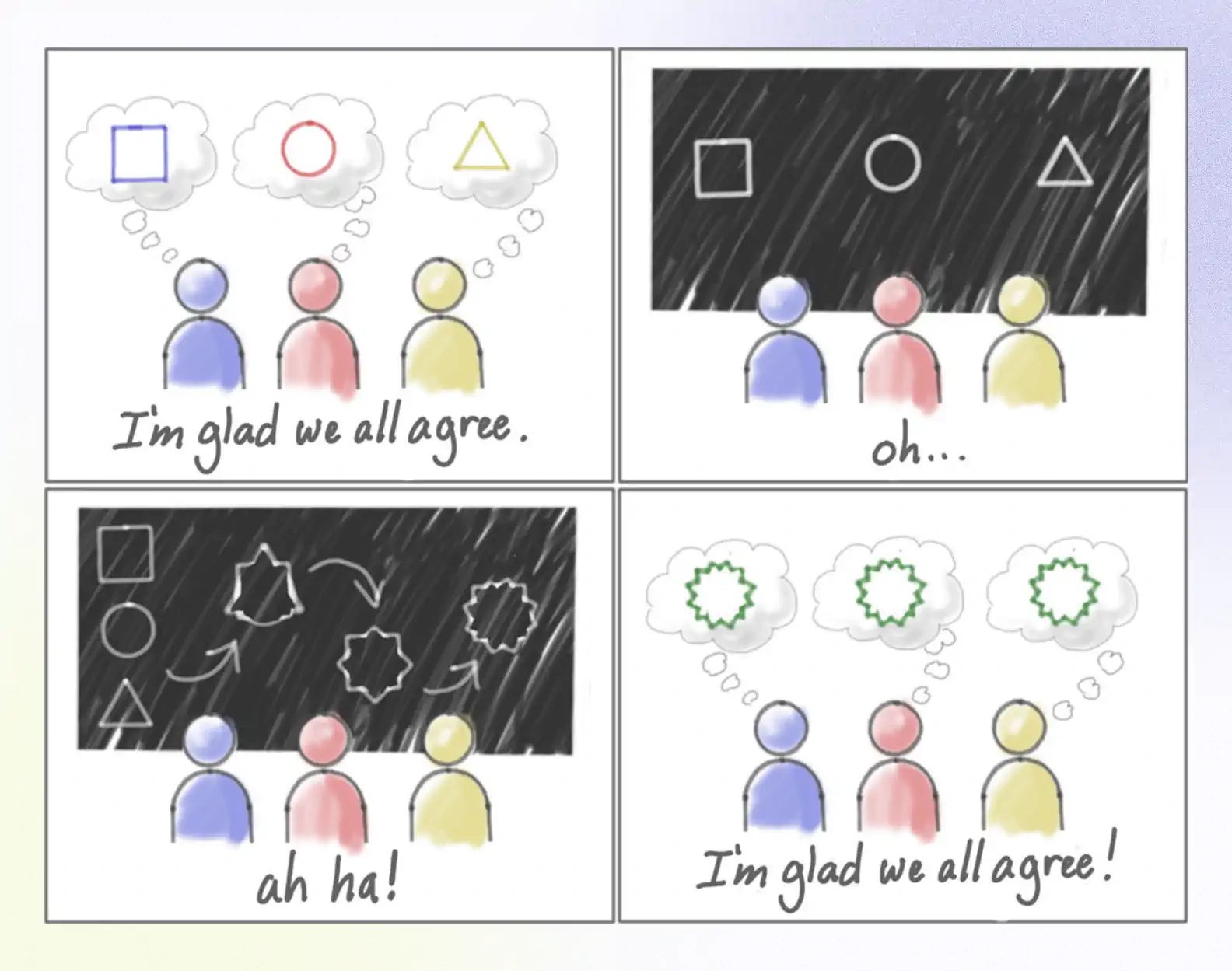
If you’ve ever played keyword bingo at work, I bet ‘alignment’ or a variation thereof comes up more often than not on the cards of product people. “So we’re all aligned” is the statement at the end of the meeting. Alignment is often just a social agreement; it’s the “nodding in the meeting” where everyone says “yes” to avoid conflict or simply because they want to move on.
In my work, I advocate for creating a “shared understanding” an outcome of any meeting or process. Instead of a social agreement, we leave with acognitive state where everyone actually perceives the “shape” of the thing being discussed in the same way.
The concept is often attributed to Jeff Patton’s User Story Mapping book, from which I share the image in this post. I think it’s applicable in all contexts where you are working on something with other people.
Here is how I see the differences:
Alignment is superficial: You can have alignment without understanding. It can happen when you agree on the words but you each have a completely different mental model of the outcome.
Shared understanding is structural: It is the result of the an active, collaborative process, where you have hammered out the nuances until the “squares, circles, and triangles” in everyone’s heads finally match.
Alignment is a “yes” vs. Understanding is a “how”: When a team is merely aligned, they walk out of the room and discover they are building three different things. When a team has shared understanding, they walk out of the room knowing exactly how the pieces fit together.
The danger of conflating the two is that it gives us a false sense of security. We mistake the quiet room for a unified team.
In my experience, we often treat these things as a byproduct of a meeting rather than an active practice. I’ve spent many hours in “context-free” “agendaless” meetings where we share thoughts, agree on a path, and then leave without a single artifact to show for it… or worse, leave it to AI to create a summary that no-one reads. More on that in a bit.
Over time, and with the opportunities I’ve had to work with some strong product and agile thinkers, I’ve come to realise that visualiation is a key way to cultivate a practive around shared understanding.
Starting with a question
“Do we have an artefact to visualise this conversation?” This has become my default question at the start of any meeting or workshop. I don’t think this should be limited to say story mapping (for which the illustration was initially created). Whether we are journey mapping, event storming, prioritising or just untangling a complex decision, the artifact serves as the facilitator.
When I work with teams, I try to get something on a board; Miro, Mural, or a at least a shared document on screen. Virtual whiteboards are the best for this as everyone can literaly be on the same screen.
By creating stickies on a board, we start telling a story or narrative. Then by inviting others to “take the pen” and edit the visualization in real-time, we find that we move from passive listening to active ownership. The board becomes the “common picture” that brings together.
Cultivating a process
- Start with the Canvas: We don’t start by talking; we start by opening a shared space (Miro or Mural) dedicated to the specific outcome we are chasing.
- The First Stroke: I (or whoever is closest to the problem) takes the pen first to outline the initial shape of the idea.
- Pass the Pen: We digitally—pass the pen around. Everyone who wants gets a turn to iterate, edit, and challenge what’s on the board. This isn’t just about “getting it down”; it’s about making sure everyone’s mental model is actually reflected in the work.
- The Artifact as Anchor: Once we finish, we don’t just close the tab. We take a snapshot of that board and attach it to the relevant Jira ticket or email etc, but the board itself remains the “single source of truth” for that conversation and we return to it whenever there’s an evolution.
In product work, I’ve found that keeping all discovery and all conversations for a single outcome on the same board, the context never gets lost. Recording the occasional board talk track helps onboard people and it’s not “context-free mulch” scattered across different meeting notes; it’s a living map that grows as our understanding grows.
Bonus: Some thoughts on how AI could impact creating a shared understanding
There’s genuine excitement around AI transcription tools (would’ve been amazing when I was doing user research for my MA), but we have to be honest about the limitations. We are now drowning in AI generated text. How many people are actually going back to read a full transcript or a summary after a call? And when you do, it’s often hard to connect the bullet point back to the context in which it was raised.
One thought I had is could there be a future (or a present?) where AI acts as a real-time sketch artist rather than just a transcriber. A tool that maps our conversations visually as they happen, creating a living canvas that we can validate together before we even leave the room. I’ve experimented with doing something like this with a JSON to Mural https://github.com/themarkness/JSON-Mural app, which takes written documentation and turns it in to a more visual and collaborative artefact.
Either way as a rule of thumb, I’d say if we are talking about it, we are mapping it!